Introduction
I was halfway through Attack on Titan’s final season when KissAnime vanished overnight. No warning. No alternative. Just a blank screen where 300+ bookmarked episodes once lived.
That 2020 shutdown forced me into a three-year deep dive through the chaotic world of free anime streaming. I’ve clicked through malware-riddled popups, tested VPN configurations, watched servers crash mid-episode, and yes—received a scary email from my ISP. I’ve bookmarked sites that disappeared within weeks and stuck with platforms that somehow keep delivering years later.
Here’s what nobody tells you upfront: there’s no perfect free anime site. But there are smart ways to watch without wrecking your device, breaking laws, or settling for 480p garbage quality. This guide breaks down the only sites I actually use in 2024, organized by safety and legality—so you can make informed choices instead of clicking random Reddit links and hoping for the best.
My Testing Process: How I Evaluated 40+ Anime Sites
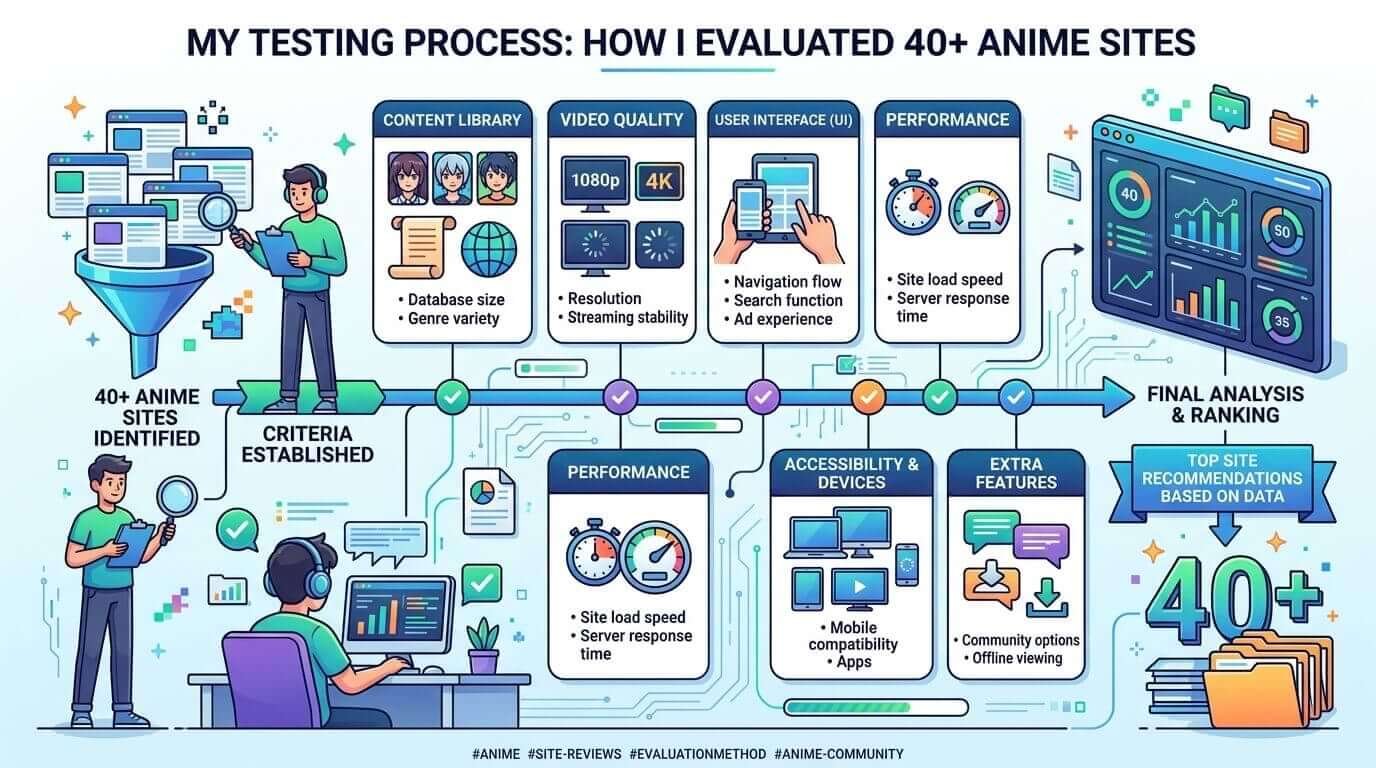
I evaluated each site across six criteria: legal status, content library size, video quality consistency, ad intrusiveness, mobile compatibility, and malware risk through direct testing with protected browsers over 36 months.
Between 2021 and 2024, I systematically tested over 40 anime streaming platforms. Not just visiting them once—I’m talking weekly usage, tracking uptime, noting when domains changed, and monitoring which sites actually kept their promises.
My evaluation criteria:
- Legal status – Licensed content vs. pirated uploads
- Library depth – Can I find obscure 90s shows or just current-season hits?
- Video quality – Consistent 1080p or choppy 720p at best?
- Ad experience – Annoying but manageable vs. malware delivery system
- Mobile functionality – Does it actually work on phones without dedicated apps?
- Longevity – Still alive after 6+ months or destined to vanish?
I used dedicated browsers with anti-tracking extensions, documented every popup and redirect, and ran malware scans after each testing session. This isn’t a list compiled from other lists—it’s ground-truth experience from someone who’s actually clicked these links hundreds of times.
Understanding the Legal Landscape: What You Need to Know
Legal anime sites have licensing agreements with studios and distributors; gray-area sites host pirated content without authorization. While watching (not downloading) pirated streams occupies a legal gray zone in most countries, copyright holders can request ISPs to monitor or warn users.
Let’s address the elephant in the room: most “free anime sites” operate in legal gray areas or outright violation of copyright law.
Legal sites have licensing deals with Japanese studios, distributors like Funimation (now merged with Crunchyroll), or other rights holders. They’re allowed to stream this content—usually with ad support or limited free tiers alongside premium subscriptions.
Gray-area and illegal sites host pirated content. Someone ripped it from legal sources or Japanese broadcasts and uploaded it without authorization. Using these sites doesn’t typically result in legal action against individual viewers in the US, UK, Canada, or most of Europe—enforcement targets uploaders and site operators, not watchers.
However, your Internet Service Provider can detect this activity and may send warning notices, especially if copyright holders file complaints.
I’m not your lawyer. This article provides information, not legal advice. You’re responsible for understanding and following laws in your jurisdiction.
That said, Many anime fans navigate this reality because legal options have historically been limited, region-locked, or arrived months after Japanese releases. The situation has improved dramatically since 2020, which is why my framework starts with legal options.
Tier 1: Completely Legal Free Anime Sites (Start Here)
Crunchyroll’s free tier offers the largest legal library (1,000+ titles) with ads; Tubi provides 200+ classic series ad-supported; RetroCrush specializes in pre-2000s anime. All are completely legal, safe, and require zero sketchy workarounds.
Start here. Seriously. These platforms won’t trigger ISP warnings, infect your device, or suddenly vanish. The trade-off? Ads and sometimes delayed episode releases.
Crunchyroll (Free Tier)
Crunchyroll remains the gold standard for legal anime streaming, even after its 2022 merger with Funimation.
Pros:
- Largest legal library: 1,000+ titles, including current-season simulcasts
- New episodes often within hours of Japanese broadcast
- 1080p quality on most content
- Excellent subtitle quality (professional translations, not machine-generated)
- Works flawlessly on mobile browsers and dedicated apps
Cons:
- Ad breaks during episodes (typically 3-4 per 24-minute episode)
- Some premium-exclusive titles not available on free tier
- Occasional geo-restrictions on specific shows
Best for: Viewers who want current-season anime legally and don’t mind ads. If you’re watching popular ongoing series like Demon Slayer, My Hero Academia, or Jujutsu Kaisen, this should be your first stop.
Tubi
Owned by Fox Corporation, Tubi offers a surprisingly robust anime section among its general entertainment catalog.
Pros:
- Completely free, no account required
- 200+ anime titles, including classics (Cowboy Bebop, Trigun, Yu Yu Hakusho)
- High-quality streams with professional dubs and subs
- Clean interface, minimal technical issues
- Works on smart TVs, mobile, and browsers
Cons:
- Smaller anime library compared to dedicated platforms
- Fewer current-season shows (focuses on completed series)
- Ad frequency similar to traditional TV
Best for: Casual viewers exploring classic anime or rewatching favorites without subscriptions.
Pluto TV (Anime Channel)
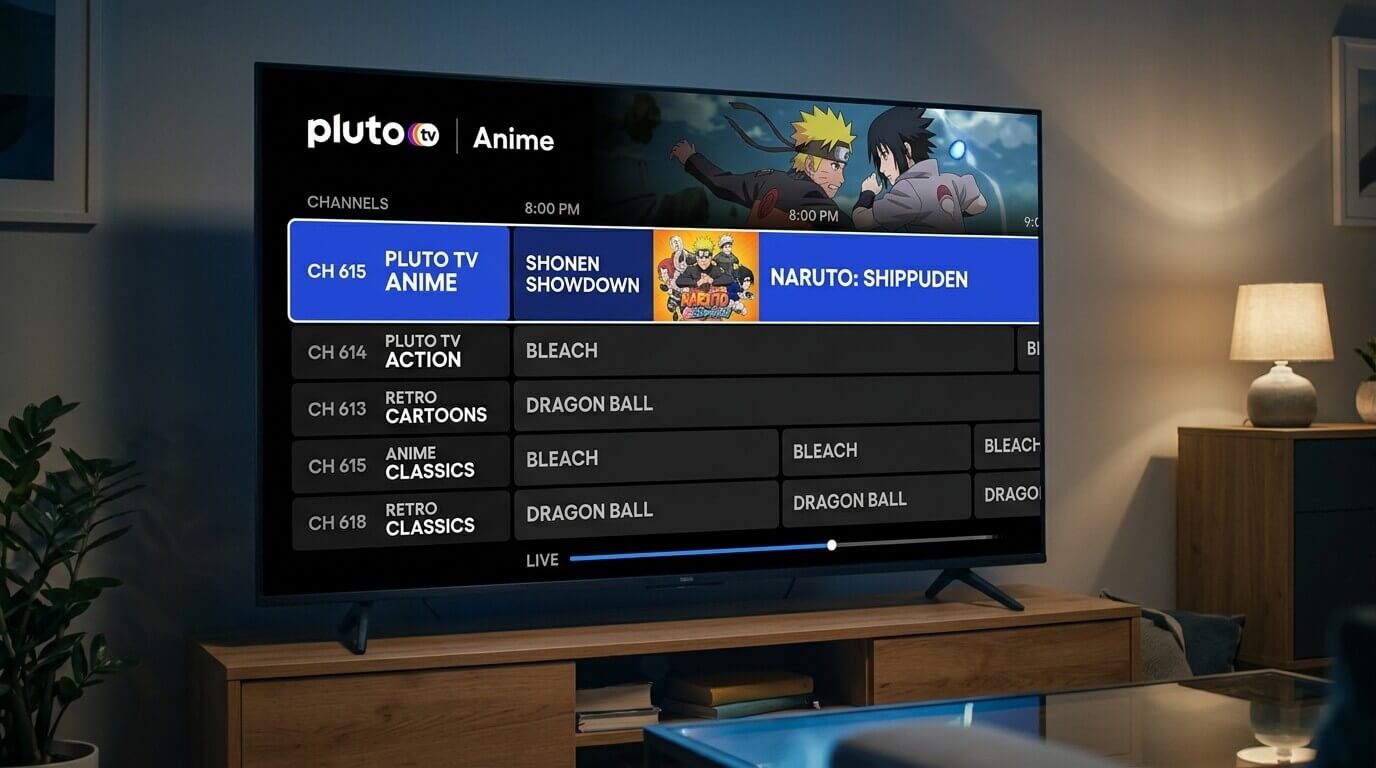
Pluto TV operates like traditional cable channels, running 24/7 with scheduled programming.
Pros:
- Dedicated anime channels (multiple streams)
- No account required
- Legitimate licensing
- Good for background viewing or discovering shows randomly
Cons:
- No on-demand; you watch whatever’s currently airing
- Can’t pause or rewind live streams
- Limited library compared to on-demand services
Best for: Viewers who enjoy the “turn on the TV and see what’s on” experience rather than selecting specific episodes.
RetroCrush
Specializes exclusively in classic anime from the 70s, 80s, and 90s.
Pros:
- Largest legal collection of vintage anime
- Titles unavailable elsewhere (Fist of the North Star, Rose of Versailles)
- Free tier includes full access to the library
- Passionate curation with historical context
Cons:
- Zero current-season content
- Ads interrupt viewing
- Niche appeal—if you want modern anime, look elsewhere
Best for: Anime historians and viewers interested in the medium’s evolution.
If these legal options cover your viewing needs, stop here. You’re getting safe, legitimate access without risk. But I understand many readers are here because legal options don’t have that obscure light novel adaptation or that show region-locked outside Asia. That’s where Tier 2 comes in.
Tier 2: Gray-Area Sites (Use With Protection)
These piracy-based sites offer massive libraries and instant access but carry legal and security risks. Essential protection includes browser-based ad blockers (uBlock Origin), avoiding downloads, and never entering personal information. Use at your own risk after implementing these safeguards.
Full transparency: These sites host unlicensed content. They exist in a legal gray zone and could disappear anytime due to DMCA takedowns or domain seizures. I’m documenting them because they represent the reality of how millions watch anime, and pretending they don’t exist helps no one.
Essential Protection Setup First
Before visiting any Tier 2 site, implement these three protections:
1. Ad Blocker (Non-Negotiable)
Install uBlock Origin (available for Chrome, Firefox, Edge, Safari). Not “AdBlock” or “AdBlock Plus”—specifically uBlock Origin. Free anime sites fund themselves through advertising networks that often include malicious ads. This blocks them before they load.
2. Antivirus Software
Ensure real-time scanning is active. Windows Defender works fine; Malwarebytes offers stronger protection. Don’t click anything without this running.
3. Behavior Rules
- Never download .exe files from these sites
- Never enter email addresses or create accounts
- Never click pop-unders (if an ad blocker misses one)
- Close any window claiming you’ve won prizes or that your device is infected
9anime (Currently: 9anime.to, 9anime.id variants)
The most consistent survivor in the piracy streaming space since KissAnime’s shutdown.
Pros:
- Massive library covering obscure titles
- Multiple server options if one fails
- Both sub and dub versions
- 1080p quality on most content
- An active community maintains uptime
Cons:
- Frequent domain changes (bookmark current working domain)
- Aggressive ads without an ad blocker
- Legal risks (pirated content)
Reality check: This is piracy. It’s popular because it works well from a technical standpoint, but you’re accessing unlicensed content.
Risk level: Medium-High (legal risk), Medium (malware risk with ad blocker)
How to use safely: Visit only with uBlock Origin active, never click anything outside the video player, bookmark the current domain directly rather than clicking search results (which include phishing clones).
Zoro.to (Previously AniWatch.me)
Known for an exceptionally clean interface with minimal ads, even without blockers.
Pros:
- Best user interface among piracy sites
- Fewer ads than competitors
- Fast servers with minimal buffering
- MAL (MyAnimeList) integration for tracking
Cons:
- Smaller library than 9anime
- Occasional downtime during server migrations
- Still unlicensed content with legal risks
Reality check: Feels almost like a legitimate service, which makes it easy to forget it’s still piracy.
Risk level: Medium (legal risk), Low (malware risk)
How to use safely: Even though ads are minimal, keep uBlock Origin active. The site’s cleanliness has made it a target for phishing clones—ensure you’re on the correct .to domain.
Gogoanime (Multiple mirror domains)
One of the oldest surviving piracy platforms, constantly shifting domains.
Pros:
- Comprehensive library including rare OVAs
- Fast upload of new episodes
- Reliable uptime despite takedown attempts
Cons:
- Extremely aggressive ads without a blocker
- Multiple fake clones (finding the real site is challenging)
- Video quality inconsistent across uploads
Reality check: A functional mess. Works if you know what you’re doing, nightmare for newcomers.
Risk level: High (legal risk), High (malware risk without protection)
How to use safely: Only access with uBlock Origin AND verify the domain through community sources (r/animepiracy subreddit maintains updated lists). Never use without ad blocking—the unblocked ad experience is genuinely dangerous.
Aniwave (Formerly 9anime variant)
Split from the main 9anime network, offering similar content with different management.
Pros:
- Similar library to 9anime
- Sometimes faster uploads of seasonal shows
- Multiple quality options
Cons:
- Less stable than main 9anime
- Domain changes even more frequently
- Smaller server network (more buffering)
Reality check: Backup option when primary sites experience downtime.
Risk level: Medium-High (both legal and malware)
How to use safely: Same protocols as 9anime. Consider this your Plan B, not your daily driver.
Important reality check on Tier 2: These sites exist because they fill gaps legal services still have—simulcast delays in some regions, incomplete catalogs, dropped licenses. But they’re also unpredictable. A site working today might redirect to a scam tomorrow. Domains change constantly to avoid legal action. If you choose to use them, you accept these risks.
Tier 3: Sites I Actively Avoid (And Why You Should Too)
Avoid sites requiring software downloads, .apk installations, cryptocurrency miners, or credit card “age verification.” Red flags include excessive pop-unders (5+ per click), fake download buttons, and domains registered within the past 3 months.
Not all free anime sites are equal. Some are actively malicious, designed to infect devices or steal information rather than deliver content.
Sites requiring downloaded “players”: If a site insists you download their custom video player, close the tab. Legitimate streaming uses HTML5 video—requiring downloads indicates malware delivery.
Cryptocurrency miners: Some sites run hidden scripts using your CPU to mine cryptocurrency. Your device heats up, slows down, and wears out faster while they profit. Red flags: unusual CPU usage spikes, browser lag while streaming.
“Free” sites demanding credit cards: Any “free” anime site asking for credit card information to “verify age” is phishing for financial data. Real free sites never require payment information.
Pop-under hell: If clicking anywhere triggers 5+ pop-unders even with an ad blocker, the site is prioritizing malicious ad revenue over user experience. Abandon it.
Examples to avoid (domains change, but patterns persist):
- Any site ending in .ru or .cc (common malware hosting extensions)
- Sites cloning legitimate names with typos (Crunhyroll, 9anme)
- Platforms advertising on sketchy message boards rather than communities
- Sites with copyright-free descriptions (“We definitely don’t have licensed content”)
I won’t link directly to dangerous sites—that defeats the purpose. The pattern recognition above helps you identify threats independently.
The Truth About Free Anime Sites Nobody Tells You
Free anime sites survive through advertising revenue (legal sites) or operate temporarily before domain seizures (piracy sites). There’s no “secret perfect site”—every option involves trade-offs between legality, convenience, safety, and library completeness.
After three years in this ecosystem, here’s what the listicles won’t say:
Why free sites have ads: Bandwidth costs real money. A platform streaming thousands of HD episodes to millions of users pays substantial hosting fees. Legal free sites cover this through advertising partnerships. Piracy sites use shadier ad networks (hence the malware risk), but the economic model is identical—ads pay for servers.
Quality vs. convenience trade-offs: You cannot have all of: (1) completely free access, (2) zero ads, (3) full catalog including obscure titles, (4) perfect legal safety, and (5) instant uploads of new episodes. Every platform sacrifices at least two. Crunchyroll’s free tier gives you (1), (3), and (4) but includes ads and occasional delays. Piracy sites offer (1), (3), and (5) but sacrifice (4) entirely and compromise safety.
Library limitations reality: Even the most comprehensive piracy site doesn’t have everything. Licensing issues, lost media, and obscure OVAs create gaps everywhere. Legal platforms face even tighter restrictions based on regional licensing deals. If you’re searching for a specific rare title, you might need to try multiple sources or accept that it’s temporarily unavailable.
The subscription question: After testing dozens of free options, I pay for Crunchyroll. Not because free alternatives don’t exist, but because the time saved avoiding malware, the absence of ISP warning stress, and supporting creators outweighs $8/month for me personally. Your calculation may differ—which is fine. But be honest about what your time and peace of mind are worth.
How to Protect Yourself While Streaming Free Anime

Use browser-based ad blockers (uBlock Origin), maintain updated antivirus software, avoid downloads from streaming sites, and never input personal information. For enhanced privacy on gray-area sites, consider a VPN, though it’s not strictly necessary for streaming in most jurisdictions.
Whether using legal sites with aggressive ads or piracy platforms, these protections minimize risk:
The Three-Layer Defense:
Layer 1 – Browser Extension (uBlock Origin): Blocks malicious ads before they load. Install from official browser extension stores only, never third-party sites. Enable all filter lists in settings for maximum protection.
Layer 2 – Antivirus (Active Scanning): Windows Defender (built into Windows 10/11) provides baseline protection. Malwarebytes offers stronger detection of streaming site threats. Run scheduled scans weekly.
Layer 3 – Behavior Discipline: Never download files claiming to be video players, codecs, or “required for streaming.” Legitimate streams use HTML5—no downloads necessary. Never create accounts on piracy sites using real email addresses (burner emails only if absolutely required). Never enter personal or financial information.
VPN Consideration: Virtual Private Networks hide your IP address from sites and ISPs. For legal sites, VPNs are unnecessary. For piracy sites, they add privacy but won’t make illegal activity legal. If you choose a VPN, paid services (NordVPN, Mullvad) offer better security than free options, which often monetize by logging and selling your data—defeating the purpose. I don’t personally use a VPN for anime streaming, relying instead on legal sites and protective browsing when occasionally checking piracy platform updates for this type of research.
Mobile-Specific Protection: Mobile browsers support ad blockers (Firefox for Android allows uBlock Origin; iOS has content blockers like AdGuard). The smaller screen makes accidental ad clicks more likely—extra caution required.
Mobile Apps vs. Browser Streaming
Browser streaming is safer than third-party apps for gray-area sites. Legal platforms (Crunchyroll, Tubi) offer secure official apps, but piracy site .apk files often contain malware. Always choose browser access over sideloaded apps.
The convenience of dedicated apps is tempting, but mobile apps from piracy sites create unique risks.
Why browsers are safer: Browser-based streaming contains threats to the browser sandbox—malicious code can’t easily access broader device functions. Downloaded apps, especially Android .apk files from outside the Google Play Store, request dangerous permissions and can install malware with device-wide access.
Legal platform apps are safe: Official apps from Crunchyroll, Tubi, and other Tier 1 services downloaded from Apple App Store or Google Play Store undergo security vetting. Use these without concern.
Piracy site apps are dangerous: Third-party app stores and direct .apk downloads from anime piracy sites frequently contain malware, cryptocurrency miners, or spyware. The app may work for streaming while simultaneously compromising your device. Browser streaming avoids this entirely.
My practice: I use official apps for legal services and browser-only access (with uBlock Origin on Firefox Android) for any Tier 2 research. I’ve never installed an .apk from an anime piracy site and never will—the risk massively outweighs any convenience gain.
FAQs About Free Anime Streaming Sites
What is the safest site to watch anime for free?
Crunchyroll’s free tier is the safest free anime option. It’s completely legal, supported by official licensing agreements, contains no malware risk, and offers 1,000+ titles with professional subtitles and dubs. The trade-off is ad breaks during episodes, but your device and legal standing remain completely safe.
Are free anime sites illegal?
It depends on the site. Legal free sites like Crunchyroll, Tubi, and RetroCrush have licensing agreements, making them completely legal. Piracy sites hosting unlicensed content (9anime, Gogoanime, etc.) violate copyright law.
Watching (not downloading) from piracy sites occupies a legal gray area in most countries—enforcement typically targets uploaders rather than viewers, but ISPs can monitor activity and send warnings.
Can you get viruses from free anime sites?
Yes, especially from piracy sites without proper protection. Malicious advertising networks on unlicensed streaming sites can deliver malware through pop-unders, fake download buttons, and compromised video players
. Legal sites (Tier 1) don’t carry this risk. For piracy sites, browser-based ad blockers (uBlock Origin) and active antivirus software dramatically reduce infection risk. Never download .exe files or “required players” from streaming sites.
Is Crunchyroll completely free?
Crunchyroll offers both free and premium tiers. The free tier provides access to over 1,000 anime titles with ad-supported streaming and 1080p quality on most content.
Limitations include ad breaks (3-4 per episode), delayed access to some new episodes (premium gets immediate access), and exclusion of certain premium-only titles. Premium subscription ($7.99/month as of 2024) removes ads and unlocks the full catalog.
What happened to KissAnime?
KissAnime, one of the largest anime piracy sites, was permanently shut down in August 2020 following legal action from Japanese copyright holders and hosting provider compliance with DMCA takedowns.
Multiple fake sites claiming to be “KissAnime” appeared afterward, but the original platform and its operators never returned. This shutdown triggered a migration to alternatives like 9anime and Gogoanime.
Do free anime sites have English dub?
It varies by site and specific title. Legal sites (Crunchyroll, Tubi) offer professional English dubs for many popular series but not all—availability depends on licensing agreements.
Piracy sites typically host both subbed and dubbed versions when dubs exist, but quality can be inconsistent (fan dubs vs. official dubs). Most free sites clearly label “DUB” vs. “SUB” on episode listings.
Why do free anime sites have so many ads?
Streaming high-definition video to thousands of simultaneous users requires expensive server bandwidth and storage.
Free sites cover these costs through advertising revenue—either legitimate ad partnerships (legal sites) or shadier ad networks paying higher rates (piracy sites). Legal free platforms balance ads to maintain viewability; piracy sites often use more aggressive ad formats to maximize revenue before potential domain seizures.
Final Recommendations: Where to Start Today
After three years of testing this landscape, here’s my honest recommendation framework:
If you want zero legal or security risk, Start and end with Tier 1 legal sites. Crunchyroll’s free tier covers current-season anime, Tubi handles classics, and RetroCrush fills vintage gaps. Combined, these represent thousands of hours of content with zero downside.
If legal options don’t have what you need: Implement the three-layer protection (ad blocker, antivirus, behavior discipline) before exploring Tier 2. Start with Zoro.to for its cleaner interface, fall back to 9anime for broader library coverage. Accept the legal gray area and understand these sites can vanish anytime.
If something feels wrong, trust that instinct: Close the tab. No anime episode is worth malware infections or compromised personal data. Legitimate alternatives always exist—even if it means waiting for legal releases or purchasing specific titles.
The free anime streaming landscape will keep changing. Sites will shut down, new ones will emerge, and legal services will (hopefully) continue improving their free tiers. What won’t change: the need to balance convenience against safety and legality.
Your next action: Bookmark Crunchyroll’s free tier today. Watch legally when possible. If you choose to venture into gray areas, protect yourself first. And never, ever download “required players” from streaming sites.