Introduction
Twelve elite assassins enter the arena, and eleven are guaranteed to die. That premise gives juni taisen zodiac war its instant hook—but what makes the series memorable is not the body count. It is the way every victory arrives hollow, every backstory lands too late, and even the final wish feels emotionally bankrupt.
Many viewers finish this anime with the same frustration: they understand who won, but not why the ending feels so bleak. This guide resolves that confusion. You will get the full thematic breakdown, character analysis, ending explanation, and the real reason Juni Taisen leaves no one—not even the winner—truly satisfied.
What Is Juni Taisen Zodiac War About?
Juni Taisen Zodiac War is a death tournament anime adapted from Nisio Isin’s novel, where twelve mercenary warriors representing the Chinese zodiac fight for a single wish-granting prize. Its real focus is not combat spectacle, but fatalism, identity collapse, and the cost of ambition.
Created from the novel by Nisio Isin and animated by Graphinica, the series follows a rigid structure: twelve zodiac-themed fighters swallow poisoned gems and must kill each other within twelve hours to survive and claim one wish.
Unlike conventional tournament anime, the mechanics are deliberately cruel. The poison deadline ensures urgency, while flashback-heavy storytelling reveals each fighter’s motivations only after their fate is sealed.
That structure creates emotional irony: viewers understand characters best only when they are beyond saving.
Why Does Juni Taisen Feel So Different From Other Battle Royale Anime?
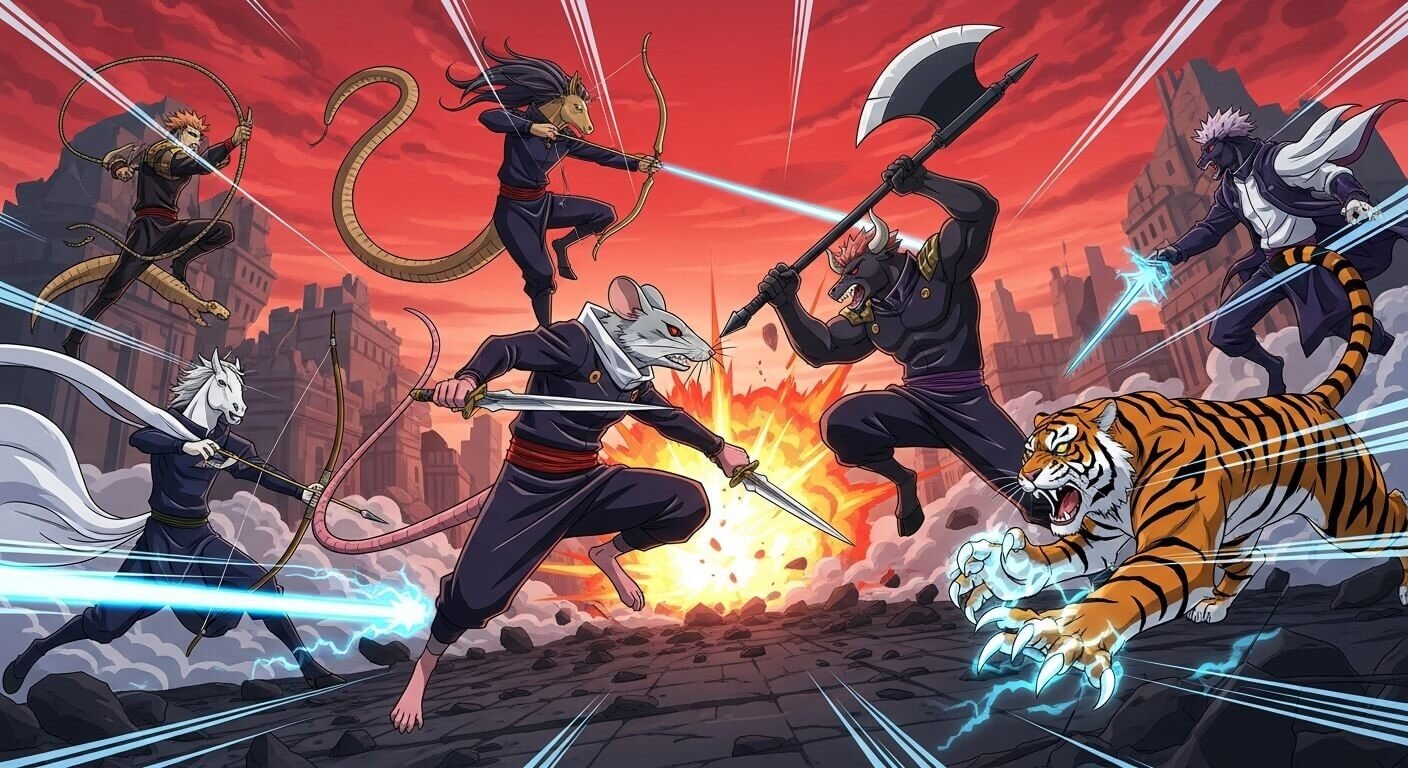
Juni Taisen stands apart because it treats death as inevitable, not suspense. The question is rarely “who survives next,” but “what personal illusion dies with each fighter.”
Most elimination anime rely on escalating twists. Juni Taisen does the opposite.
Its uniqueness comes from three structural choices:
- Characters are introduced as legends, then dismantled psychologically
- Flashbacks often arrive after death, reversing emotional pacing
- Victories expose emptiness instead of triumph
Compare that to titles like Fate/Zero or Mirai Nikki, where winners still achieve narrative catharsis. In Juni Taisen, catharsis is intentionally denied.
This is a tragedy in tournament clothing.
Who Wins Juni Taisen Zodiac War?
The final winner of juni taisen zodiac war is Nezumi, the Rat warrior, whose victory reflects strategic detachment rather than strength. His wish matters because it reveals the emotional emptiness at the center of the tournament.
Nezumi survives because he rejects the emotional traps that destroy everyone else.
While stronger fighters dominate physically, Nezumi’s advantage is probabilistic foresight. His ability to simulate multiple futures makes him uniquely suited for a contest where impulsive conviction gets people killed.
Why Nezumi’s Wish Is So Important
At the climax, Nezumi is granted one wish—but instead of a grand ambition, he cycles through countless possible desires mentally before landing on a painfully human conclusion: ordinary fulfillment matters more than absolute power.
That ending is devastating because it exposes the entire war as spiritually meaningless.
The winner receives omnipotence only after losing the capacity to value it.
Who Are the Strongest Fighters in the Zodiac War?

Raw strength in Juni Taisen does not determine survival. The strongest fighters combine combat ability, adaptability, and psychological discipline—not brute force alone.
Top 5 Strongest Fighters Ranked
1. Usagi (Rabbit)
Usagi is the most dangerous destabilizer in the series. His necromantic ability turns corpses into obedient puppets, multiplying battlefield pressure exponentially.
2. Nezumi (Rat)
Not the strongest physically, but tactically supreme. Predictive simulation makes him nearly impossible to outmaneuver.
3. Uuma (Horse)
A disciplined close-range powerhouse with battlefield restraint that many others lack.
4. Inoshishi (Boar)
Her military command skills and weapons expertise make her one of the deadliest direct combatants.
5. Tora (Tiger)
Erratic but lethal. Her instability makes her unpredictable, which becomes both a strength and a fatal flaw.
A recurring misconception is that the winner must be the strongest. Juni Taisen rejects that logic entirely.
Survival belongs to the least psychologically compromised.
Why the Rabbit Warrior Changes Everything
Usagi matters because he transforms Juni Taisen from a tournament into horror. His corpse manipulation ability destroys the normal rules of elimination and forces every fighter into escalating despair.
Usagi is not just a villain. He is the narrative rupture point.
Before his full emergence, the war still resembled a competitive bracket. After him, death stops being final and becomes weaponized.
That changes audience expectations in two ways:
- Fallen warriors remain threats after death
- Emotional closure becomes impossible
Usagi represents contamination—the idea that violence in Juni Taisen never ends cleanly.
His presence also explains why the anime’s emotional tone collapses into dread midway through the series.
Why There Are Zero Happy Endings in Juni Taisen
There are no happy endings because Juni Taisen is built on ironic futility: every fighter enters with desire, but the structure guarantees that desire becomes meaningless before resolution.
Each zodiac warrior carries a deeply personal motive:
- Redemption
- Revenge
- Legacy
- Recognition
- Escape
Yet the tournament strips those motives of meaning.
A useful analogy: Juni Taisen is like an auction where every bidder sells their soul for currency they cannot spend.
Even Nezumi’s survival is emotionally sterile. He wins existence, not joy.
That is why the ending lingers. It refuses the emotional reward audiences are conditioned to expect.
Is Juni Taisen Still Worth Watching in 2026?
Especially for viewers who value psychological tragedy over conventional action payoff. Juni Taisen remains one of anime’s sharpest deconstructions of battle royale storytelling.
By 2026 standards, the animation remains visually competent rather than groundbreaking, but its narrative design still feels distinct.
Watch it if you want:
- High-concept death game structure
- Symbolic character writing
- Bleak philosophical endings
Skip it if you need:
- Long-form character development arcs
- Optimistic emotional payoff
- Traditional heroic closure
Its MAL audience score has remained consistently stable in mid-tier recommendation bands, showing lasting cult relevance rather than mainstream dominance.
Conclusion
Three truths define juni taisen zodiac war: the strongest fighter does not win, every death serves thematic purpose over shock value, and the final wish exposes the emptiness beneath the entire war.
If you watched the series only for combat, it feels cruel. If you read it as tragedy, it becomes far richer.
The next step is simple: revisit the final episode after understanding Nezumi’s emotional arc. The ending lands differently once you see the war as a study in hollow victory.
FAQs
What is Juni Taisen Zodiac War about?
It is a 12-person death tournament where zodiac-themed mercenaries fight for one wish. Beneath that premise, the story explores fatalism, regret, and the collapse of personal ambition.
Who wins Juni Taisen Zodiac War?
Nezumi, the Rat warrior, wins through foresight, patience, and emotional detachment rather than brute force.
Why are there no happy endings in Juni Taisen?
Because the narrative is structured as tragedy. Every character’s desire is invalidated by the cost required to pursue it.
Who is the strongest fighter in Juni Taisen?
Usagi is the most dangerous overall due to his corpse-control power, though Nezumi is the most strategically effective.
Is Juni Taisen based on manga or light novel?
It began as a light novel written by Nisio Isin, later adapted into manga and anime formats.
Why is the Rabbit warrior so important?
Usagi breaks the tournament’s logic by weaponizing the dead, shifting the story from combat drama into existential horror.
Is Juni Taisen worth watching in 2026?
Yes, especially if you enjoy dark psychological anime with symbolic storytelling and morally bleak conclusions.