
Introduction
The Kaiji anime adapted roughly one-third of the full manga. Everything that made you grip the screen — the tension, the humiliation, the impossible odds — only gets more relentless from where the show stopped. If you finished the anime and felt like the story was over, it wasn’t. It was just getting started.
Millions of fans discover Kaiji through the anime and never find out what the manga contains. That’s the gap this guide closes. You’ll know exactly where to pick up the Kaiji manga after anime, what arcs to read, what changes in tone and stakes, and why readers consistently say the manga surpasses the show.
What the Kaiji Anime Actually Covers
The Kaiji anime ran for two seasons. Season 1 (2007–2008) adapted Tobaku Mokushiroku Kaiji — the first manga part, covering Restricted Rock Paper Scissors aboard the Espoir and the Human Derby bridge crossing. Season 2 (2011) adapted Tobaku Hakairoku Kaiji, covering the underground pachinko arc and the labor camp.
The Kaiji anime covers Parts 1 and 2 of the manga. The full manga runs six parts. Anime-only viewers have seen less than half the complete story, and the arcs that follow are widely considered the most psychologically intense of the entire series.
Both seasons are faithful adaptations — the anime didn’t cut major content. It simply stopped at Part 2. Fukumoto kept writing Kaiji for over two more decades after that point.
Where the Kaiji Manga Picks Up After the Anime
Part 3 — Tobaku Datenroku Kaiji — begins immediately after the events of Part 2. Kaiji is back to square one: broke, in debt, living in poverty. The structure resets in a way that feels familiar, but hits differently now. You understand who Kaiji is. Watching him fall again carries real weight.
Part 3 introduces the Chinchirorin arc — a dice gambling game in an underground casino controlled by Hyoudou’s organization. It builds slower than the E-Card or pachinko arcs from the anime, but what Fukumoto does with the psychology of every player at that table is surgical. The tension doesn’t come from the dice. It comes from watching people betray each other in increments.
After the anime, the Kaiji manga continues with Part 3 (Tobaku Datenroku Kaiji), a new gambling arc set in an underground casino. Kaiji is still broke and in debt. The tone becomes more patient and psychological, but the stakes and betrayals escalate beyond anything in Seasons 1 or 2.
The Full Kaiji Manga Reading Order
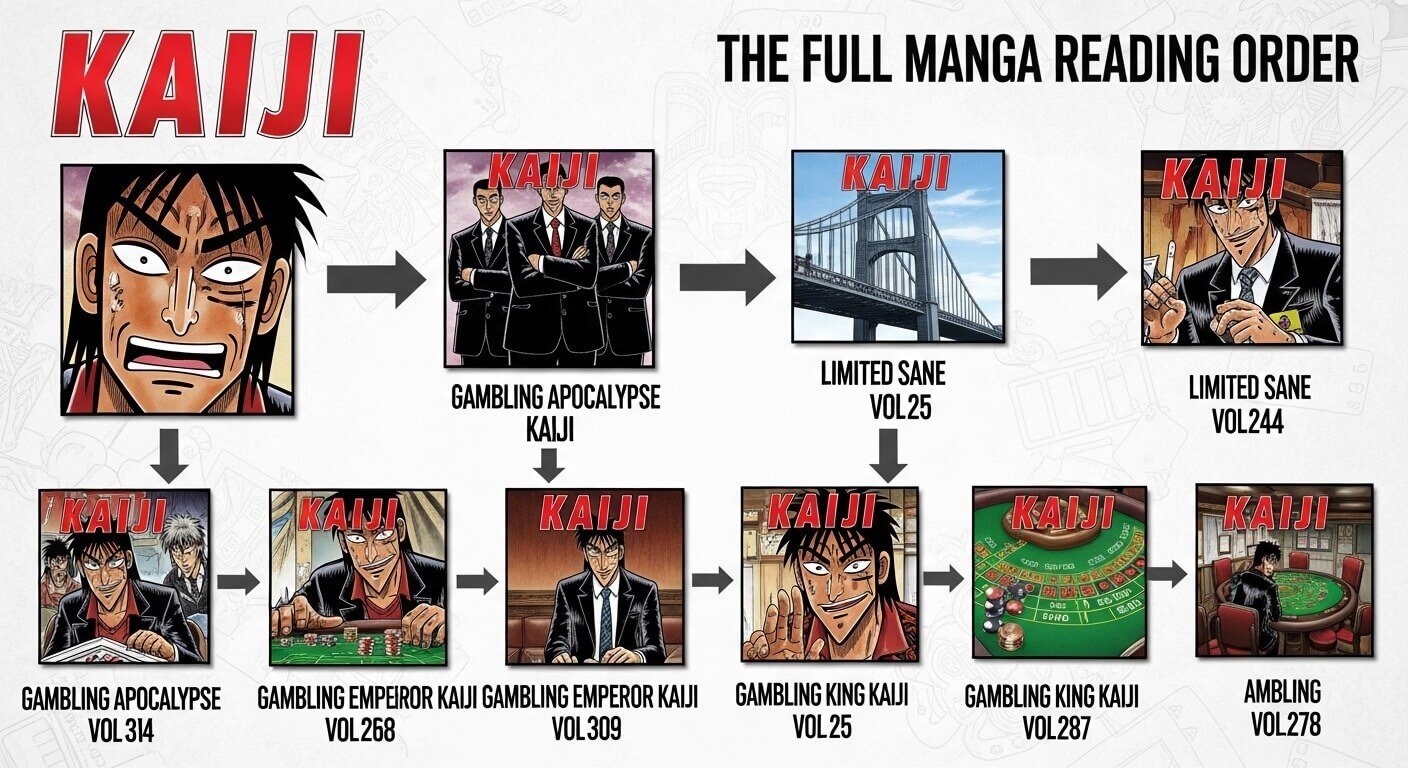
Part 1 — Tobaku Mokushiroku Kaiji (1996–1999) Covered by Anime Season 1. Skip unless you want expanded character moments; the show is compressed.
Part 2 — Tobaku Hakairoku Kaiji (2000–2004) Covered by Anime Season 2. Same recommendation — re-reading is optional after watching.
Part 3 — Tobaku Datenroku Kaiji (2004–2010) Start here after the anime. The Chinchirorin arc. Slower build, deeper psychology, and a climax that reframes everything you assumed about Kaiji’s relationship with luck.
Part 4 — Tobaku Datenroku Kaiji: 24-Oku Dasshutsu Hen (2010–2017) The mahjong arc. Frequently cited as the highest point of the entire series. Fukumoto spent seven years on this arc. It shows.
Part 5 — Tobaku Datenroku Kaiji: Kazuya-Hen (2017–2020) Shifts partial focus to Kazuya, Hyoudou’s son. Divisive among readers but essential for the complete story.
Part 6 — Tobaku Datenroku Kaiji: 17-Oku Hen (2020–ongoing) Still being published as of 2025. The current arc.
The Kaiji manga reading order after the anime is: Part 3, Part 4, Part 5, Part 6. Start at Part 3 immediately after finishing the anime. Each part follows directly from the last — no skipping, no filler arcs to navigate around.
What Changes Between the Anime and the Manga
The anime is tense. The manga is suffocating.
That’s a structural difference, not hyperbole. Fukumoto’s pacing in manga form is built around internal monologue. Kaiji’s thoughts unspool across panels in ways the anime compressed into seconds of voice-over. A single hand of mahjong in Part 4 spans hundreds of pages because every decision is dissected from multiple angles before it’s made.
The internal logic goes deeper. The anime tells you Kaiji is calculating. The manga shows you the calculation itself — the reasoning, the doubt, the moment a plan begins to crack.
The art style is an adjustment. Fukumoto draws in a distinctive style — large noses, angular faces, unconventional by any standard. Within 30 pages, it stops mattering. Every micro-expression becomes readable because Fukumoto draws exaggeration with precision.
The humor is darker. The manga leans further into the absurdity of Kaiji’s situation. His failures are funnier and more humiliating. In black and white panels, that tonal balance lands perfectly.
The Kaiji manga differs from the anime primarily in pacing and psychological depth. The manga expands Kaiji’s internal monologue dramatically, making each gamble feel lived-in rather than spectacle. Readers consistently report that the manga feels more personal and more brutal than either anime season.
The Best Arcs in the Kaiji Manga (Ranked)
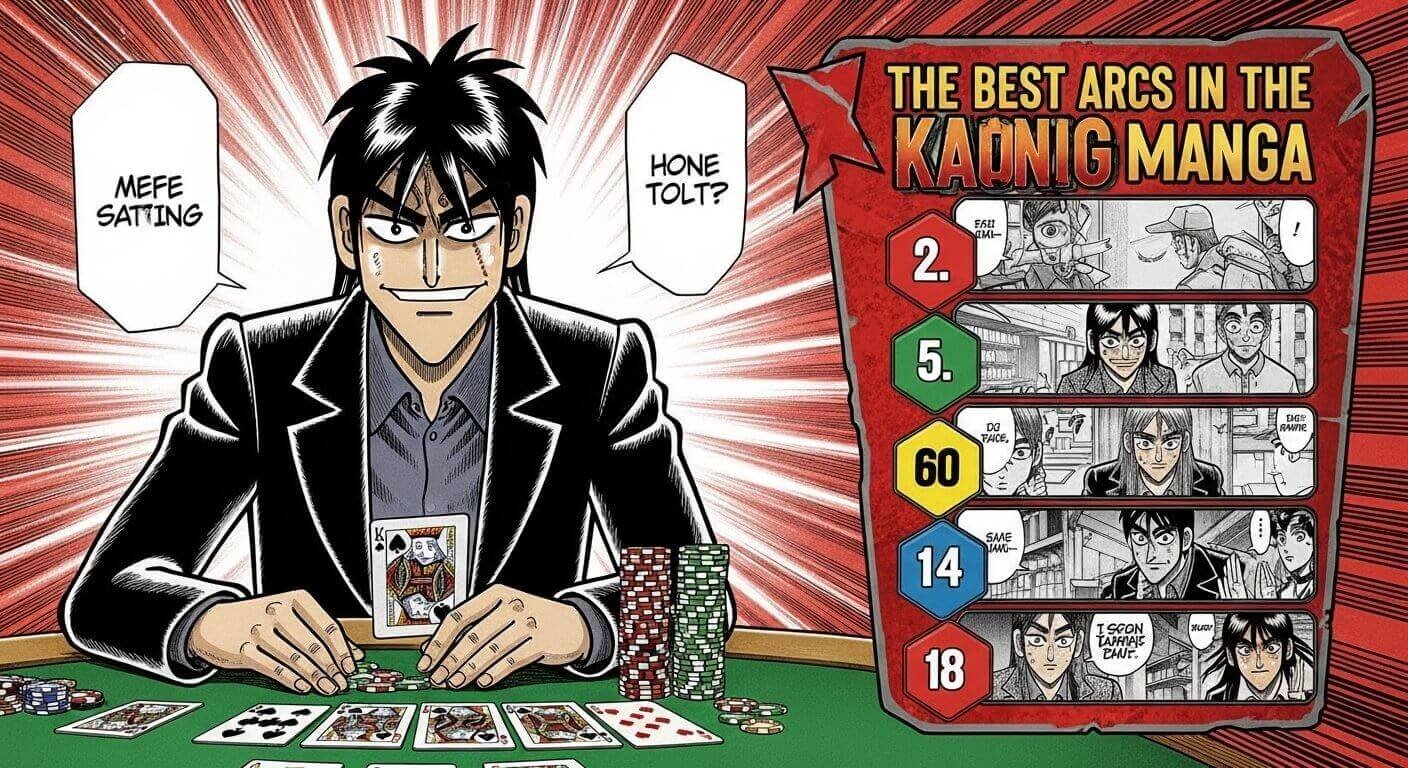
1. The Mahjong Arc (Part 4) The consensus peak of the series. Seven years of publication. A single extended game functioning as both a gambling thriller and a meditation on pride, class warfare, and self-destruction.
2. Restricted Rock Paper Scissors (Part 1) The arc the anime adapted in Season 1 — included here because the manga version contains panel sequences the show cut that add real character texture.
3. Chinchirorin / Underground Casino (Part 3) The entry point after the anime. Slower than what you’re used to, but the secondary characters at the dice table are among the best in the series.
4. Pachinko / Labor Camp (Part 2) The manga version is marginally more detailed in explaining how Kaiji spots the flaw in the machine.
5. Kazuya Arc (Part 5) Divisive. Some call it the weakest arc; others argue it deepens the antagonist roster in ways Part 6 pays off directly.
The best arc in the Kaiji manga after the anime is the Mahjong Arc in Part 4 — a single gamble that spans hundreds of chapters and builds to escalating psychological complexity. Most readers cite it as the definitive reason the manga outclasses the anime adaptation.
Is the Kaiji Manga Worth Reading After the Anime?
Yes — but with honest context.
The Kaiji manga is not casual reading. Fukumoto writes long. Part 4 alone is longer than most complete manga series. The pacing demands patience that the anime did not require. If you watched both anime seasons and wanted more, the manga delivers exactly that — more of everything, amplified.
The post-anime material contains Fukumoto’s most developed work. The anime adapted strong arcs, but the ones it didn’t adapt are the reason Kaiji is considered one of the best psychological manga ever written.
One genuine warning: start Part 3 expecting a different pace. The first 30–40 chapters are deliberately slow — Fukumoto is re-establishing the world and the psychology of desperation. Push through it. The payoff is earned.
The Kaiji manga is absolutely worth reading after the anime. Parts 3 and 4 are widely considered superior to anything the anime adapted — more psychologically complex, more patient in buildup, and more devastating in conclusion. Readers who quit Part 3 early consistently report regretting it when they returned.
FAQs
Q: How many parts does the Kaiji manga have? The Kaiji manga has six parts, all by Nobuyuki Fukumoto. Publication began in 1996 and continues as of 2025. The anime adapted Parts 1 and 2. Parts 3 through 6 are the post-anime continuation, totaling hundreds of additional chapters across roughly two decades of serialization.
Q: Does the Kaiji manga have an ending? As of 2025, the Kaiji manga has no completed ending — Part 6 is still ongoing. Parts 1 through 5 are fully concluded and available to read in their entirety. The series has been in continuous publication for nearly 30 years with no announced end date from Fukumoto or Kodansha.
Q: Where can I read the Kaiji manga in English? The official English release is limited. Parts 1 and 2 received official localization from Kodansha. Parts 3 onward rely on fan translations, which are widely available through dedicated manga reading communities. Official digital releases remain incomplete as of this writing.
Q: Is the Kaiji manga better than the anime? Among readers who experienced both, the manga is generally considered superior — particularly Parts 3 and 4. The expanded internal monologue and Fukumoto’s long-form pacing create psychological intensity the anime couldn’t fully replicate. The anime is an excellent entry point. The manga is the complete experience.
Q: Do I need to reread Parts 1 and 2 before starting Part 3? No. If you watched both anime seasons, you have sufficient context to begin at Part 3. The adaptations are faithful enough that you won’t miss critical information. Re-reading Parts 1 and 2 in manga form is worthwhile eventually but not necessary before starting.
Q: Who wrote the Kaiji manga? Kaiji is written and illustrated by Nobuyuki Fukumoto, a Japanese manga author known almost entirely for gambling and psychological thriller manga. His other major works include Akagi and Ten, which share thematic DNA with Kaiji. Fukumoto’s angular art style and hyper-detailed internal monologue are defining features of the series.
Q: What is the first Kaiji manga arc after the anime? The first arc after the anime is the Chinchirorin arc in Part 3 (Tobaku Datenroku Kaiji). It introduces an underground casino where Kaiji enters a dice gambling game. It builds more slowly than the anime arcs but establishes the psychological framework for everything in Parts 4 through 6.
Conclusion
The Kaiji anime is the introduction. The manga is the full story — and it runs deep.
Three things matter most if you’re starting now: begin at Part 3 without skipping, push through the slower opening chapters, and clear your schedule before starting Part 4. The Mahjong Arc is the kind of reading experience that redefines what manga as a format can do.
The Kaiji manga after anime isn’t a supplement to the show. It’s the destination the show was pointing toward. Fukumoto spent nearly 30 years building this story. The anime gave you the first two arcs. The rest is waiting.