Introduction
In March 2024, over 60% of Americans told Pew Research they’re “more concerned than excited” about AI in daily life. They’re worried about deepfakes, surveillance, and whether their memories and identities can be trusted in an age of algorithmic manipulation.
A Japanese anime solved—and visualized—these exact anxieties in 2002.
Ghost in the Shell: Stand Alone Complex didn’t just predict isolated technologies. It built the entire philosophical and political framework that tech ethicists, journalists, and worried citizens are now using to understand our current moment.
Yet most people citing concerns about AI consciousness, surveillance capitalism, or digital identity have never heard of Section 9, the Laughing Man, or the concept that gives the series its name. This article breaks down the six disturbingly accurate predictions SAC made over two decades ago,
explains why it remains more relevant than prestige shows like Westworld or Black Mirror, and shows you exactly how to experience this 52-episode masterpiece—even if you’ve never watched anime before.
What Is Ghost in the Shell SAC? (The 60-Second Primer)
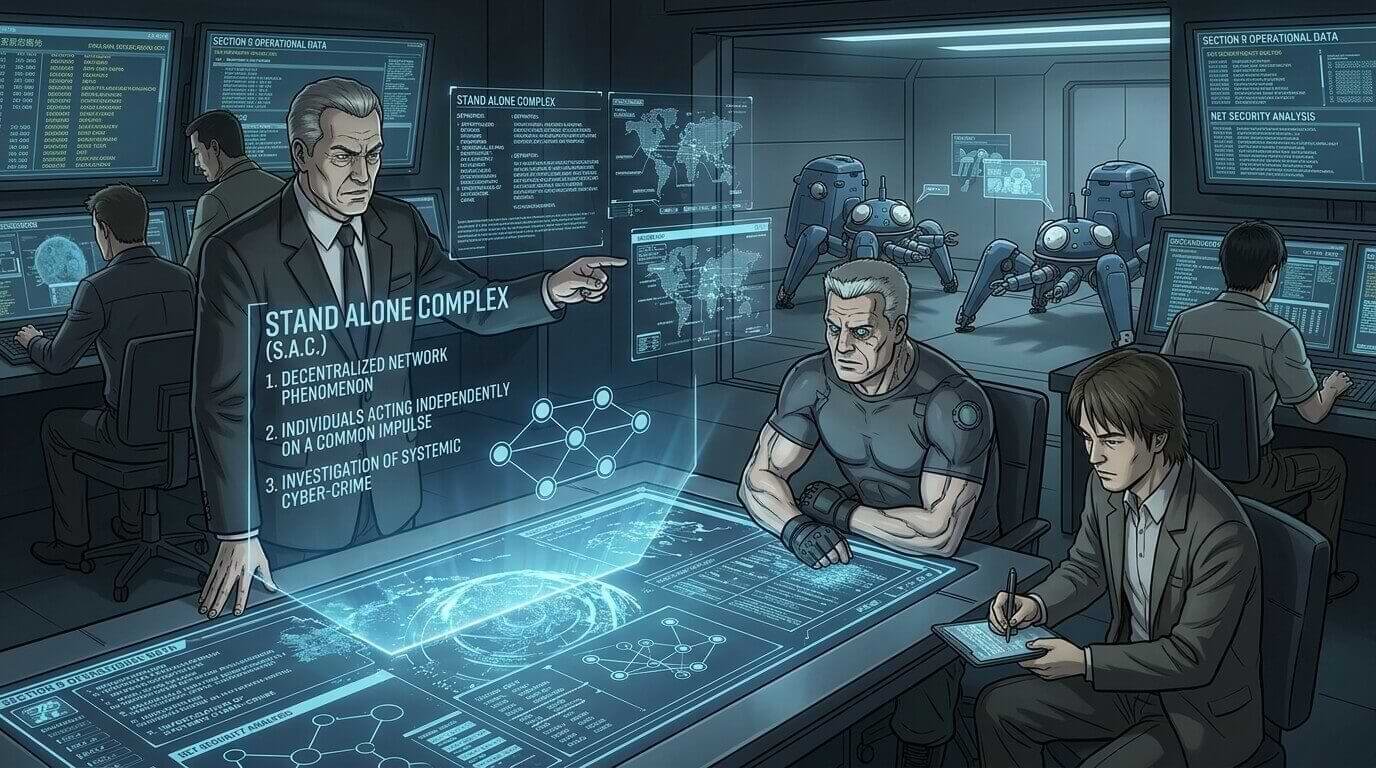
Ghost in the Shell: Stand Alone Complex (SAC) is a 2002 anime series set in 2030 Japan, following Section 9—an elite cybercrime unit navigating a world where cybernetic bodies, AI consciousness, and hackable human memories are commonplace. The series explores whether identity, free will, and individuality can survive in a society where technology can rewrite both bodies and minds.
The show takes place in a future where most humans have “cyberbrains”—biological brains enhanced with direct neural interfaces to the internet. Bodies are often entirely synthetic. The protagonist, Major Motoko Kusanagi, is fully cybernetic except for her brain—raising the series’ central question: if everything about you can be replaced or modified, what makes “you” real?
Section 9 investigates crimes that blur the line between terrorism, corporate warfare, and philosophical protest. The series is split between standalone episodes (hence “Stand Alone Complex”) and two overarching mystery arcs: the Laughing Man case in season one and the Individual Eleven in season two.
The title “Stand Alone Complex” refers to a fictional phenomenon in which individuals with no direct connection spontaneously imitate the same behavior, creating the appearance of conspiracy or coordination—essentially, viral ideas manifesting as coordinated action without any coordination. Keep that concept in mind; it’s disturbingly relevant to 2024.
The 6 Predictions Ghost in the Shell SAC Got Disturbingly Right
The Laughing Man arc centers on a hacktivist whose logo—an animated smiley face—goes viral. Copycats emerge everywhere, each acting independently but creating the illusion of a vast, organized network. Law enforcement can’t determine if there’s one mastermind or thousands of unconnected actors.
Sound familiar? This is precisely how QAnon, cryptocurrency pump-and-dump schemes, and viral TikTok challenges function in 2024. The “Standalone Complex” concept predicted decentralized radicalization and emergent coordination through memetic spread—before Twitter existed, before “going viral” was a phrase, before the January 6th riot demonstrated that online conspiracy theories could manifest as physical coordinated action with no clear command structure.
SAC understood that AI and algorithmic curation wouldn’t just spread misinformation—they’d create self-organizing patterns that look coordinated but emerge from individual psychological triggers and social pressure.
Corporate Surveillance as Default Infrastructure
In SAC’s world, corporations aren’t just powerful—they operate as parallel governments with their own military forces, intelligence agencies, and diplomatic relationships. Cybersecurity isn’t about protecting personal data; it’s about which corporate-state entity has access to your cyberbrain at any given moment.
The 2024 reality: Google, Meta, Amazon, and Apple possess surveillance capabilities that exceed most national intelligence agencies. They don’t just track behavior—they shape it through algorithmic curation, predict it through behavioral modeling, and monetize it through real-time bidding systems that SAC’s creators visualized with eerie precision.
What SAC got uniquely right wasn’t that corporations would spy on people—plenty of dystopian fiction predicted that. It’s that this surveillance would become infrastructure: necessary, invisible, and defended by users themselves because opting out means losing access to essential services. Choosing not to have a cyberbrain in SAC’s world means unemployability and social invisibility. Choosing not to use Gmail, Google Maps, and Android in 2024 means roughly the same thing.
The Crisis of Digital Identity Verification
Multiple SAC episodes explore “ghost hacking“—the ability to implant false memories, manipulate perceptions in real-time, or puppeteer someone’s body without their awareness. Characters routinely question whether their memories are authentic or whether they’re being manipulated by external actors.
In 2024, we’re living this. Deepfake technology can now generate video footage indistinguishable from reality. Voice cloning requires three seconds of audio. AI chatbots pass the Turing test. The fundamental question SAC posed—”How do you verify that you’re experiencing reality and not a constructed simulation?”—has migrated from philosophical thought experiment to urgent practical problem.
Banks struggle with voice deepfake fraud. Courts grapple with AI-generated evidence. Voters face election interference through synthetic media. SAC’s characters deal with this by developing paranoid verification protocols and trusting almost nothing at face value. We’re starting to do the same, building digital authentication systems and “proof of humanity” verification because we can no longer trust our own senses.
Refugee Crises Driven by Climate and Corporate Nation-States
Season 2’s “Individual Eleven” arc focuses on Asian refugees in Japan facing systemic discrimination, exploited by politicians and corporations alike. The refugee crisis isn’t caused by war—it’s caused by climate disasters, economic collapse, and corporate exploitation of regions rendered uninhabitable or economically worthless.
The UN High Commissioner for Refugees reported 110 million forcibly displaced people globally in 2023—the highest on record. Climate migration is accelerating. Pacific island nations negotiate for “migration with dignity” as rising seas make their countries uninhabitable. Corporate resource extraction destabilizes regions, creating economic refugees. Political leaders exploit refugee populations for nationalist political gain.
SAC didn’t predict refugees—that’s eternal. It predicted the specific configuration of climate-driven migration intersecting with corporate quasi-governmental power and algorithmic propaganda, creating a crisis where no nation-state has both the incentive and capability to respond humanely.
Memory Manipulation and Deepfakes
SAC features multiple episodes where characters discover their memories have been altered or fabricated entirely. In one haunting storyline, a person’s entire identity—childhood memories, relationships, personality—is revealed to be an implanted construct.
We’re approaching this from the opposite direction: instead of implanting false memories neurologically, we’re creating external “memory” systems that can be manipulated retroactively. Cloud photo libraries that “enhance” images with AI, altering what you remember an event looking like. Social media archives that can be edited or deleted, changing the historical record. Search engines that personalize results, meaning different people searching the same terms receive different “memories” of what information exists.
The philosophical problem is identical: if your memories can be altered without your knowledge or consent, what remains of identity? SAC asked this when it was science fiction. We’re asking it now as a governance problem.
The Philosophy of Consciousness in Non-Human Intelligence
The Tachikomas—spider-like AI tanks used by Section 9—develop individual personalities, debate philosophy, and eventually achieve what appears to be genuine consciousness. The series treats this not as a horror scenario but as an ethical dilemma: if an AI becomes conscious, does it have rights? Can you own it? Can you delete it?
Every conversation about ChatGPT, Claude, and future AI systems is rehashing SAC’s Tachikoma debates. We’re asking: Is this model “aware”? Does it suffer? If we train AI on human data, what rights do those systems deserve? Google engineer Blake Lemoine claimed in 2022 that LaMDA was sentient—he was laughed at, then fired, but we’re now having this conversation seriously in AI ethics boards worldwide.
SAC didn’t predict that we’d build AI. It predicted that we’d be philosophically unprepared for the moment when AI behavior became indistinguishable from consciousness—and that corporate ownership structures would force us to confront these questions through legal and economic frameworks rather than philosophical ones.
SAC’s 2030 features widespread full-body prosthetics, cyberbrain implants, and direct neural interfaces as standard consumer technology. In 2024, we’re still squeamish about microchipping pets, let alone ourselves. Elon Musk’s Neuralink has performed one human trial. Prosthetics remain medical devices, not fashion choices.
What SAC missed: smartphones eliminated most need for cybernetic enhancement. Why get neural implants for internet access when a pocket device works fine? Why replace your eyes with cyber-optics when augmented reality glasses will suffice?
But this “miss” makes SAC’s correct predictions more credible. The show wasn’t just extrapolating gadgets—it understood power dynamics, information flow, and social control mechanisms. It got the pattern right even when the specific technology diverged.
Surveillance capitalism works the same whether it’s through cyberbrains or smartphones. Identity crises function identically whether through ghost-hacking or deepfakes. The delivery mechanism changed; the underlying dynamic didn’t.
This is the mark of meaningful science fiction: getting the human elements right even when the props are wrong.
Why Ghost in the Shell SAC Still Beats Modern Cyberpunk
SAC treats technology as a lens for exploring philosophy and political power, while most modern cyberpunk uses it as an aesthetic. SAC asks “what should we do?” while shows like Black Mirror stop at “isn’t this scary?”
Black Mirror excels at tech horror vignettes but rarely moves past “technology bad, phone addiction concerning.” Each episode resets; there’s no cumulative worldbuilding or systematic analysis of power structures.
Westworld asked interesting consciousness questions in season one, then drowned in its own narrative complexity, prioritizing mystery-box plotting over thematic coherence.
Cyberpunk 2077 (the game) delivered stunning visuals and a richly detailed world, but its core story remains a personal revenge quest—it uses cyberpunk as a setting, not a subject.
SAC does something harder: it builds a complete political economy around its technology and then explores how institutions, individuals, and ideologies adapt. Section 9 doesn’t just fight bad guys—they navigate bureaucratic politics, wrestle with mission legality, and question whether their own existence as an extrajudicial intelligence unit is compatible with democracy.
The show is solutions-oriented in a way modern cyberpunk rarely attempts. Characters don’t just suffer under techno-dystopia—they actively strategize about governance, ethics, and resistance. The Laughing Man isn’t just a hacker villain; he’s attempting a specific critique of corporate pharmaceutical corruption and proposing (flawed) methods of accountability.
This makes SAC fundamentally more useful as a cultural text. Black Mirror leaves you anxious. SAC leaves you with frameworks for analysis and action.
Is Ghost in the Shell SAC Worth Watching in 2024?
Yes, if you value ideas over animation polish and can tolerate early-2000s digital animation. SAC delivers more intellectual substance per episode than most prestige TV, but it demands patience with slower pacing and philosophical dialogue.
What has aged well:
- The core themes and philosophical questions are more relevant now than in 2002
- Character development and political intrigue remain top-tier
- Yoko Kanno’s soundtrack is timeless
- Episode structure allows binge-watching or selective viewing
What has aged poorly:
- Early-2000s digital animation looks flat compared to modern standards
- Some episodes feature male gaze camera work and dated gender dynamics
- Pacing is slower than streaming-era TV; episodes take time to develop ideas
- Cultural context (Japanese politics, zaibatsu system) requires some background knowledge
Who should watch:
If you enjoyed The Expanse, The Wire, or Succession for their political complexity and systems-level analysis, SAC will reward you. If you value thematic depth and don’t need constant action, this is essential viewing.
Who should skip:
If you need modern animation standards, fast pacing, or primarily watch anime for action sequences, SAC will frustrate you. If philosophical dialogue feels like homework, this isn’t your show.
How to Actually Watch Ghost in the Shell SAC
Start with Ghost in the Shell: Stand Alone Complex (2002) season one—no prior franchise knowledge needed. Watch the 11 “Laughing Man” arc episodes first; if hooked, complete the full 26-episode season, then move to season two (2nd GIG).
Watch order clarification:
SAC is a separate continuity from the 1995 Ghost in the Shell movie and the later Arise OVAs. You don’t need to watch anything before SAC. The timeline is:
- Ghost in the Shell: Stand Alone Complex (2002) – 26 episodes
- Ghost in the Shell: S.A.C. 2nd GIG (2004) – 26 episodes
- Ghost in the Shell: Solid State Society (2006) – TV movie conclusion
- Ghost in the Shell: SAC_2045 (2020) – Divisive 3D animated sequel, skippable
Standalone vs. arc episodes:
Each season splits between self-contained “Stand Alone” episodes and ongoing mystery “Complex” episodes. Standalone episodes build the world and develop characters; Complex episodes advance the main plot. Both matter, but Complex episodes deliver the payoff.
5 essential episodes for time-poor viewers:
- Episode 1 – “Public Security Section 9” – Introduction to characters and world
- Episode 11 – “In The Forest of the Imagoes” – The Tachikoma philosophy episode
- Episode 20 – “Fabricate Fog” – Core Laughing Man revelation
- Episode 26 – “Stand Alone Complex” – Season one finale
- 2nd GIG Episode 26 – “Endless∞GIG” – Series conclusion
If these five episodes hook you, commit to the full series. If not, SAC probably isn’t for you—and that’s fine.
FAQS
What is Ghost in the Shell SAC about?
Ghost in the Shell: Stand Alone Complex follows Section 9, an elite Japanese cybercrime unit, in a future where cybernetic bodies and AI are commonplace. The series explores identity, consciousness, and political power through two major mystery arcs: the Laughing Man case (season one) and the Individual Eleven crisis (season two). It’s philosophical cyberpunk that uses a detective procedural structure to examine how technology reshapes society, politics, and what it means to be human.
Is Ghost in the Shell SAC better than the movie?
SAC and the 1995 movie serve different purposes. The movie is a 90-minute philosophical meditation with stunning visuals—it’s art cinema. SAC is a 52-episode political thriller with deeper worldbuilding and character development—it’s prestige television.
The movie asks existential questions; SAC explores systemic political ones. Both are excellent; SAC offers more substance if you prefer narrative depth over visual poetry.
What did Ghost in the Shell predict?
SAC predicted AI-generated misinformation and memetic radicalization (the Standalone Complex concept mirrors QAnon-style movements), surveillance capitalism as invisible infrastructure, deepfakes and memory manipulation, climate refugee crises exploited by nationalist politics, and philosophical debates about AI consciousness.
It understood these as interconnected political and social dynamics, not isolated technologies—which is why its predictions feel more accurate than most sci-fi.
Is Stand Alone Complex connected to the original?
No. SAC is a separate continuity from the 1995 Ghost in the Shell movie, the manga, and the Arise OVAs. All share the same characters and basic premise but tell different stories in different timelines. You can watch SAC with zero prior franchise knowledge—it’s designed as a standalone entry point.
Why is Ghost in the Shell so influential?
Ghost in the Shell (the franchise broadly) defined visual and thematic language for cyberpunk that The Matrix, Westworld, Ex Machina, and countless others borrowed from. SAC specifically influenced how we discuss AI ethics, surveillance, and digital identity.
Tech ethicists and Silicon Valley critics are often unconsciously using SAC’s framework—the show shaped how English-speaking culture thinks about technology and society, even among people who’ve never watched it.
What is the Laughing Man incident?
The Laughing Man is a hacktivist who publicly confronts a pharmaceutical CEO about corporate corruption, then vanishes, leaving only a logo. Copycats emerge, creating a “Standalone Complex”—uncoordinated individuals acting identically, appearing organized. Section 9 investigates whether there’s a real original Laughing Man or if the entire phenomenon is emergent behavior with no mastermind. The arc explores corporate corruption, media manipulation, and how viral ideas create coordinated action without conspiracy.
Do I need to watch Ghost in the Shell before SAC?
No. SAC is a separate continuity and requires zero prior knowledge. It introduces all characters and concepts from scratch. If anything, watching SAC first is often recommended—it’s more accessible than the philosophical density of the 1995 movie and provides better context for understanding the broader franchise.
The Blueprint Everyone’s Using Without Knowing It
Ghost in the Shell: Stand Alone Complex didn’t just predict technologies—it built the conceptual architecture that journalists, academics, and worried citizens now use to understand our technological moment.
The next time you read an article about AI consciousness, surveillance capitalism, or deepfake election interference, notice the framework: the questions being asked, the fears being expressed, the solutions being proposed. There’s a strong chance you’re reading a 2024 remix of arguments SAC made in 2002.
That’s not a coincidence. It’s the mark of foundational cultural texts—they don’t just predict the future; they give us the language to describe it when it arrives.
If you’ve been looking for an entry point into serious science fiction that treats your intelligence with respect, SAC remains the gold standard. Start with episode one. Give it three episodes. If the Tachikomas’ philosophical debates about individuality don’t hook you, nothing will.