Introduction
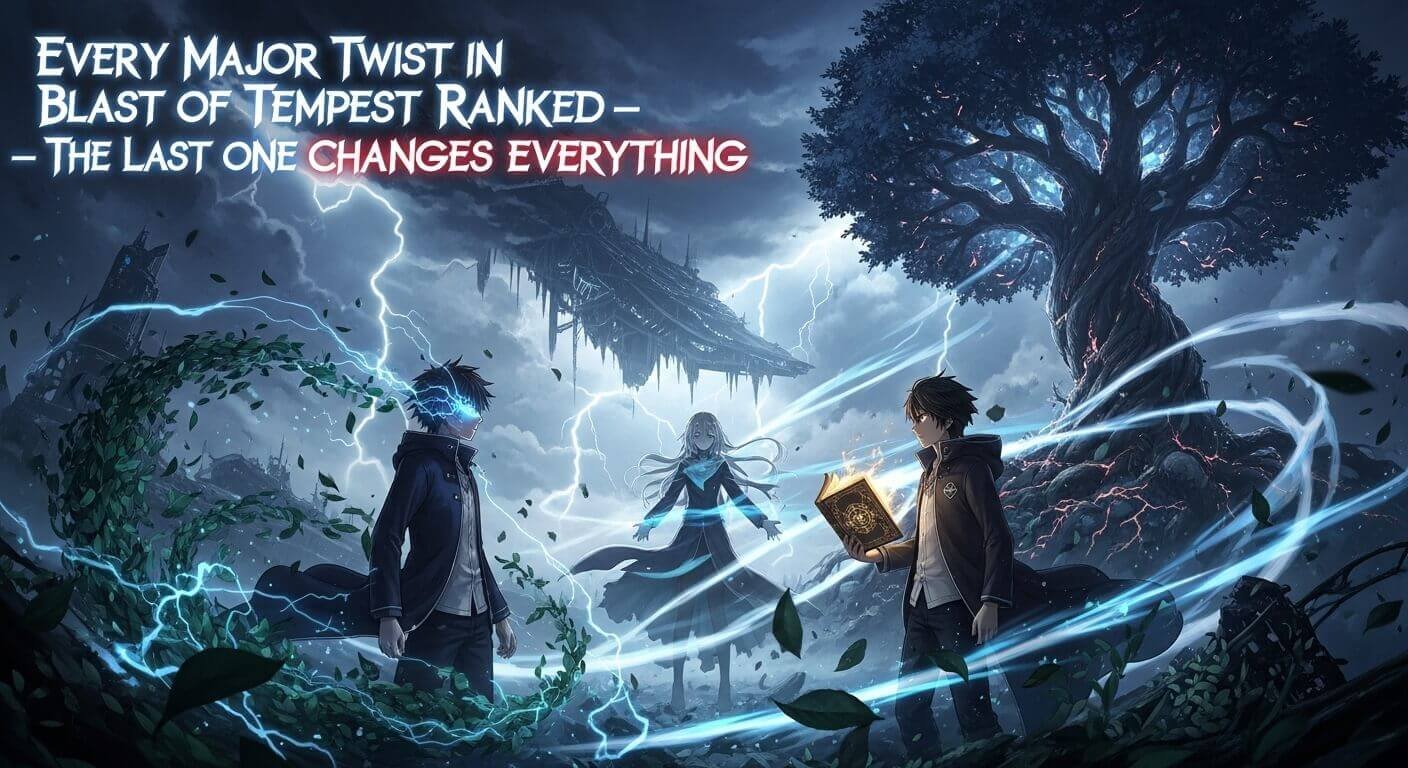
Few anime execute plot twists with surgical precision. Blast of Tempest doesn’t just surprise—it systematically dismantles everything you think you understand.
If you’ve watched the series, you already know the feeling: every few episodes, the story flips its own logic. What starts as revenge becomes philosophy. What looks like magic becomes strategy. And what seems like truth collapses into manipulation.
This breakdown ranks every major twist in blast of tempest from least shocking to absolutely reality-shattering—while explaining why each one works and how it reshapes the story.
1. Hakaze Was Never in Control
Hakaze appears powerful and in charge early on, but the twist reveals she is isolated, manipulated, and operating on incomplete information. This reframes her as a pawn rather than a strategist, shifting audience perception of power dynamics.
At the beginning, Hakaze Kusaribe is positioned as the mastermind—an exiled mage orchestrating events from a deserted island. She commands Yoshino and Mahiro, directs strategy, and appears to hold all the answers.
That illusion collapses.
Hakaze isn’t controlling events—she’s reacting to them. Her isolation strips her of real-time information, making her vulnerable to manipulation. This twist matters because it subtly rewires the narrative hierarchy.
Instead of:
- Hakaze = leader
- Yoshino/Mahiro = followers
We get:
- Hakaze = constrained strategist
- Others = unpredictable variables
This shift introduces a recurring theme: knowledge is power, not magic.
2. The Time Paradox Reveal
The story introduces a closed-loop time paradox where future actions influence past events. This twist transforms the narrative into a deterministic loop, making every decision feel both inevitable and tragic.
Time travel in anime often feels like a gimmick. Here, it becomes a philosophical weapon.
The reveal that Hakaze’s return is tied to events already set in motion creates a causal loop. Events don’t just happen—they must happen.
This changes how you interpret every scene:
- Choices stop feeling free
- Outcomes feel pre-written
- Tension becomes existential
The brilliance lies in restraint. Instead of flashy time jumps, the show uses logical inevitability.
This aligns with ideas explored in about determinism—where outcomes are fixed regardless of perceived choice.
3. Aika Was Pulling Strings From the Start
Aika’s death initially motivates the plot, but the twist reveals she influenced events before dying. This transforms her from a victim into a central architect of the story’s emotional and strategic conflict.
Aika Fuwa is introduced as a mystery.
Then she becomes something far more dangerous.
Her intelligence and foresight position her as the quiet force behind multiple outcomes. Even after death, her decisions ripple through the narrative.
What makes this twist powerful is the emotional contradiction:
- She’s dead
- Yet she shapes everything
This creates a haunting effect: the past is more powerful than the present.
Unlike typical “dead character twists,” Aika isn’t just remembered—she’s strategically relevant.
4. Samon Was Right (Mostly)
Samon appears as the antagonist, but the twist reveals his actions are logically justified. This reframes him as a necessary counterforce rather than a villain, complicating the moral structure of the story.
Samon Kusaribe starts as the obvious enemy.
He’s cold. Calculated. Ruthless.
But the deeper you go, the clearer it becomes: he’s not wrong—he’s just extreme.
His goal is to prevent catastrophic outcomes tied to the Tree of Genesis. His methods are harsh, but his reasoning is sound.
This twist does something rare:
- It removes moral comfort
- It forces you to evaluate outcomes, not intentions
According to research in narrative theory, morally ambiguous antagonists increase audience engagement by creating cognitive conflict.
Samon embodies that perfectly.
5. Yoshino’s Relationship Changes Everything
The revelation of Yoshino’s secret relationship with Aika adds emotional complexity and hidden motivation. It reframes his calm personality as controlled grief and strategic restraint.
Yoshino Takigawa is quiet. Observant. Passive.
Or so it seems.
The reveal of his relationship with Aika detonates that perception. Suddenly:
- His calmness becomes calculated
- His neutrality becomes suspicious
- His loyalty becomes layered
This twist works because it doesn’t rely on shock—it relies on reinterpretation.
You don’t learn something new. You see everything differently.
That’s the hallmark of elite storytelling.
6. The Tree of Genesis Isn’t What You Think
The Tree of Genesis appears as a source of salvation, but the twist reveals it may lead to destruction. This flips the central conflict and challenges the assumption that power equals good.
The Trees—Genesis and Exodus—represent opposing forces.
But the story refuses to simplify them.
The Tree of Genesis, initially framed as humanity’s hope, becomes increasingly questionable. Its power threatens global stability.
This twist introduces a core theme:
“Power without understanding is a catastrophe.”
Instead of good vs evil, the conflict becomes:
- Stability vs chaos
- Control vs freedom
This elevates the story from action anime to philosophical drama.
7. The Final Twist — No One Was Truly in Control
The final twist reveals that no character fully controlled events. Instead, intersecting motives, incomplete knowledge, and inevitable outcomes shaped the story. This reinforces the theme that control is an illusion.
Here’s where Blast of Tempest separates itself from nearly every anime in its genre.
There is no mastermind.
No grand puppet master.
No single “winner.”
Instead, the story reveals a system:
- Everyone acts on limited knowledge
- Every decision triggers unintended consequences
- Outcomes emerge from interaction—not control
This aligns with complexity theory, where systems behave unpredictably despite logical inputs.
The result?
A narrative that feels real.
Messy. Interconnected. Uncontrollable.
And that’s why this twist lands so hard—it doesn’t resolve the story. It explains it.
Why These Twists Work Better Than Most Anime
These twists succeed because they are built on logic, foreshadowing, and character psychology rather than shock value. Each twist recontextualizes previous events, rewarding attentive viewers and creating lasting impact.
Most anime twists rely on surprise.
Blast of Tempest relies on structure.
Here’s what sets it apart:
- Foreshadowing is precise — nothing comes out of nowhere
- Characters drive twists — not random events
- Themes stay consistent — philosophy anchors the chaos
A 2023 storytelling study found that audiences retain plot twists longer when they:
- Reframe earlier scenes
- Align with character motivations
- Reinforce core themes
This series checks all three.
Final Verdict: Which Twist Matters Most?
Three twists define the entire experience:
- Yoshino’s relationship with Aika — emotional core
- Samon’s justification — moral complexity
- Final control illusion twist — philosophical payoff
But the last one changes everything.
Because it forces you to confront a deeper truth:
Stories don’t need a mastermind to be meaningful. They need consequences.
Conclusion
Blast of Tempest isn’t just a twist-heavy anime—it’s a masterclass in narrative design.
Here’s what matters most:
- Every twist builds on logic, not randomness
- Characters—not plot devices—drive the story
- The final reveal reframes the entire series as a system, not a scheme
If you revisit Blast of Tempest after understanding these twists, it becomes a completely different experience.
Next step: Rewatch key episodes with this framework—you’ll notice details you missed the first time.
FAQs
What is the biggest twist in Blast of Tempest?
The biggest twist is the realization that no single character controlled events. The story unfolds through interconnected decisions and limited knowledge, making outcomes feel inevitable rather than orchestrated.
Is Aika the mastermind in Blast of Tempest?
No. Aika is highly influential, but she is not the mastermind. Her actions shape the story, yet she operates within the same constraints as other characters.
Why is Samon not a typical villain?
Samon’s goals are logically justified. He acts to prevent large-scale destruction, making him a morally complex antagonist rather than a purely evil character.
Does Blast of Tempest use time travel?
Yes, but in a limited and structured way. The story uses a closed-loop time paradox to reinforce determinism rather than create multiple timelines.
What makes Blast of Tempest different from other anime?
Its reliance on logic, philosophy, and character-driven twists sets it apart. Every reveal deepens the narrative instead of just shocking the audience.
Is Blast of Tempest worth rewatching?
Absolutely. The layered storytelling means a second viewing reveals foreshadowing and connections that are easy to miss the first time.