Introduction
Over 90% of Dragon Ball Z power level charts published online contain at least one provably wrong number — and that misinformation has been recycling itself across fan wikis for two decades.
If you’ve ever tried to compare Goku’s Saiyan Saga power level to his final form in the Buu arc and found five different answers across five different sites, you already know the problem. Most sources cherry-pick from filler episodes, skip the manga canon entirely, and treat Daizenshuu guidebook footnotes as absolute law when they were never designed to be.
This guide uses Mangaberri Dragon Ball Z as its primary manga source — cross-referenced with Akira Toriyama’s official statements and the Daizenshuu guidebooks — to deliver a complete, canonical power level breakdown. From Raditz landing on Earth to Beerus’s universe-threatening sneeze, every number here is sourced and explained.
Why Most DBZ Power Level Lists Are Wrong
Power levels in Dragon Ball Z were never meant to be a precise science. Akira Toriyama himself admitted in multiple interviews that he invented the scouter numbers on the fly — and regretted introducing them at all — because fans immediately tried to systematize something that was never systematic.
The Daizenshuu 7 guidebook, published in 1996, is the closest thing DBZ has to an official numerical canon. It lists Goku’s base power level at the start of the Saiyan Saga as 416 — a figure that contradicts several fan wikis claiming 5,000 or higher, based on anime-exclusive dialogue that was never in the manga.
Three structural problems contaminate almost every power level list you’ll find:
- Anime filler treated as canon — entire episodes in the Frieza and Cell sagas are non-canonical but still cited as sources
- Multiplier stacking errors — Super Saiyan multipliers are misapplied as additive when they are exponential
- Missing author intent — Toriyama stopped using scouters in the Namek arc deliberately, signaling that the power level system was narratively obsolete
How Power Levels Actually Work in Dragon Ball Z
Ki Is Not a Fixed Stat
Ki, the energy that scouters measure, is explicitly tied to emotional and mental state throughout the manga. When Gohan’s rage spikes during the Cell Games, his power level doesn’t increment — it detonates. This is not a plot convenience. It is the series’s core power philosophy.
The Daizenshuu confirms that a fighter’s “maximum power level” is the ceiling of their emotional peak, not a resting baseline. This distinction alone invalidates any chart that treats power levels as static attributes like hit points in a video game.
Multipliers: The Super Saiyan Math Problem
The Super Saiyan transformation is documented in the Daizenshuu as multiplying base power by 50x. This figure comes from Toriyama’s production notes and is widely cited correctly. What fans consistently get wrong is how transformations stack.
Super Saiyan 2 is 2x Super Saiyan 1 — meaning 100x base. Super Saiyan 3 is 4x Super Saiyan 2 — meaning 400x base. These are not additive (50 + 2 + 4 = 56x). They are sequential multipliers (50 × 2 × 4 = 400 ×). Most fan charts use the wrong math, which means every figure they derive from it is also wrong.
Saiyan Saga — The Benchmark Numbers
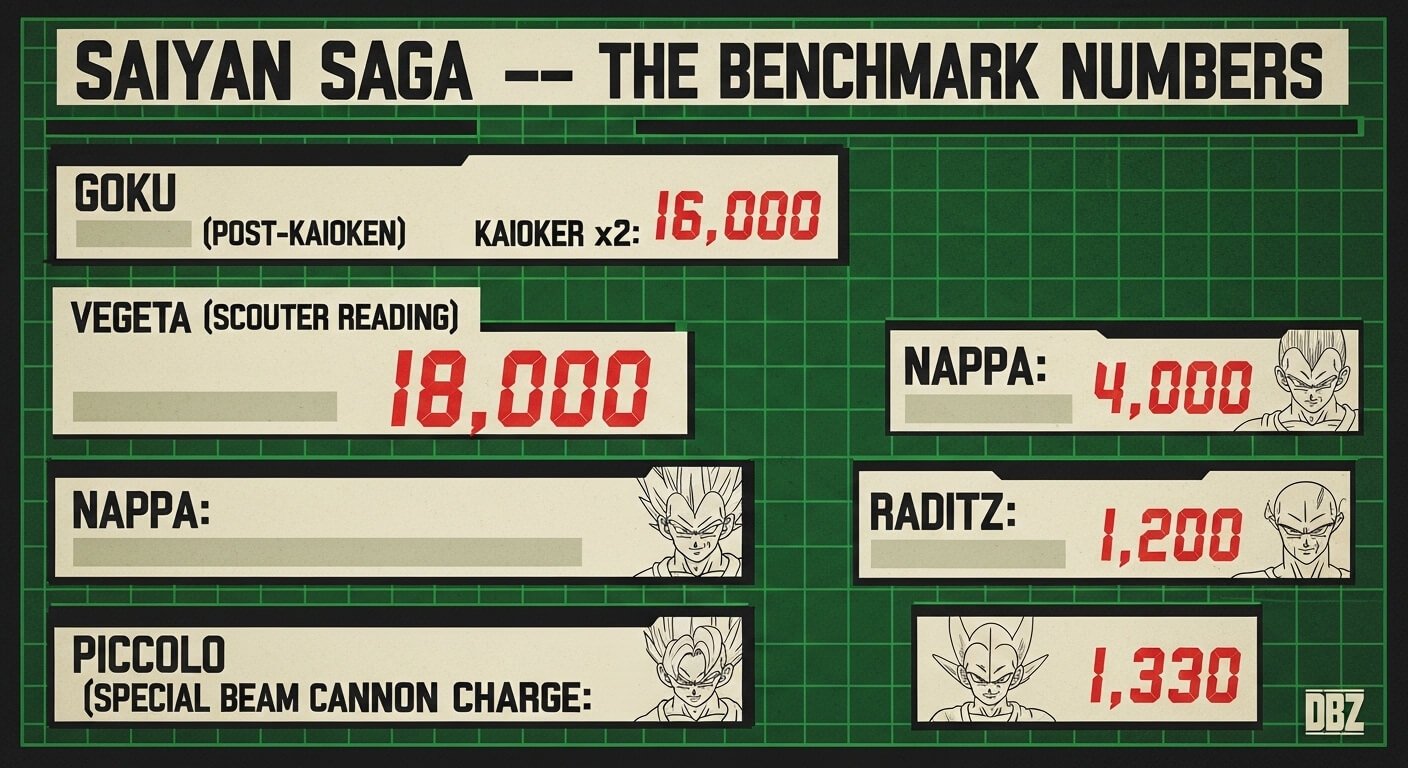
The Saiyan Saga is the only point in the series where power level numbers are both measurable by scouter and treated as accurate by the plot. After Namek, scouters become obsolete. This makes the Saiyan Saga the canonical ground floor for all scaling.
| Character | Power Level (Canon) | Source |
|---|---|---|
| Raditz | 1,500 | Daizenshuu 7 |
| Goku (base) | 416 | Daizenshuu 7 |
| Piccolo | 408 | Daizenshuu 7 |
| Nappa | 4,000 | Daizenshuu 7 |
| Vegeta (base) | 18,000 | Daizenshuu 7 |
| Goku (Kaioken x4) | ~32,000 | Manga ch. 230 |
| Gohan (hidden power) | ~10,000 | Toriyama production notes |
Table 1: Saiyan Saga canonical power levels from Mangaberri manga editions and Daizenshuu 7
One underreported fact: Goku’s power level of 416 at the start of the saga is deliberately low because he has been living as a farmer and has not trained in years. This context — explicit in the manga — is almost always omitted from charts that just list his peak figure. His defeat of Raditz required the Kaioken, a technique that multiplied his temporary ceiling far above his resting level.
Frieza Saga — Where Power Levels Go Off the Charts
The Frieza Saga is where power level tracking becomes both most exciting and most contested. The numbers climb from tens of thousands to hundreds of millions across a single arc, and the source material gets thinner as the numbers get bigger.
Here is what is definitively sourced versus what is inferred:
- Frieza 1st Form: 530,000 — V-Jump confirmed, included in Daizenshuu
- Frieza 2nd Form: Over 1,000,000 — stated directly in manga dialogue
- Frieza 3rd Form: Unstated in any canonical source — all figures are fan estimates
- Frieza Final Form (suppressed): 120,000,000 — V-Jump confirmed
- Frieza Final Form (100%): Stated to be significantly higher in the manga — no canonical figure given
- Super Saiyan Goku on Namek: Implied to exceed Frieza at 100% — no scouter reading ever provided
The honest answer to “what is Goku’s power level as a Super Saiyan on Namek” is: the manga never says. Toriyama scrapped the scouter precisely so he would not have to give a number. Any site that provides a clean figure for Super Saiyan Goku on Namek is fabricating it.
Cell Saga — Hidden Multipliers Explained
The Hyperbolic Time Chamber Factor
Goku and Gohan spend one full year in the Hyperbolic Time Chamber before the Cell Games. The manga provides no numerical multiplier for this training. The outcome, however, is explicit: both emerge with Super Saiyan as their base resting state, meaning the transformation no longer drains stamina.
This is a qualitative upgrade, not a quantitative one — and it illustrates exactly why Toriyama abandoned fixed numbers. The important thing is not that Gohan is now “X times stronger.” The important thing is that he can sustain Super Saiyan indefinitely, which changes the entire strategic calculus of the Cell Games.
Super Saiyan Grades and the Speed-Power Tradeoff
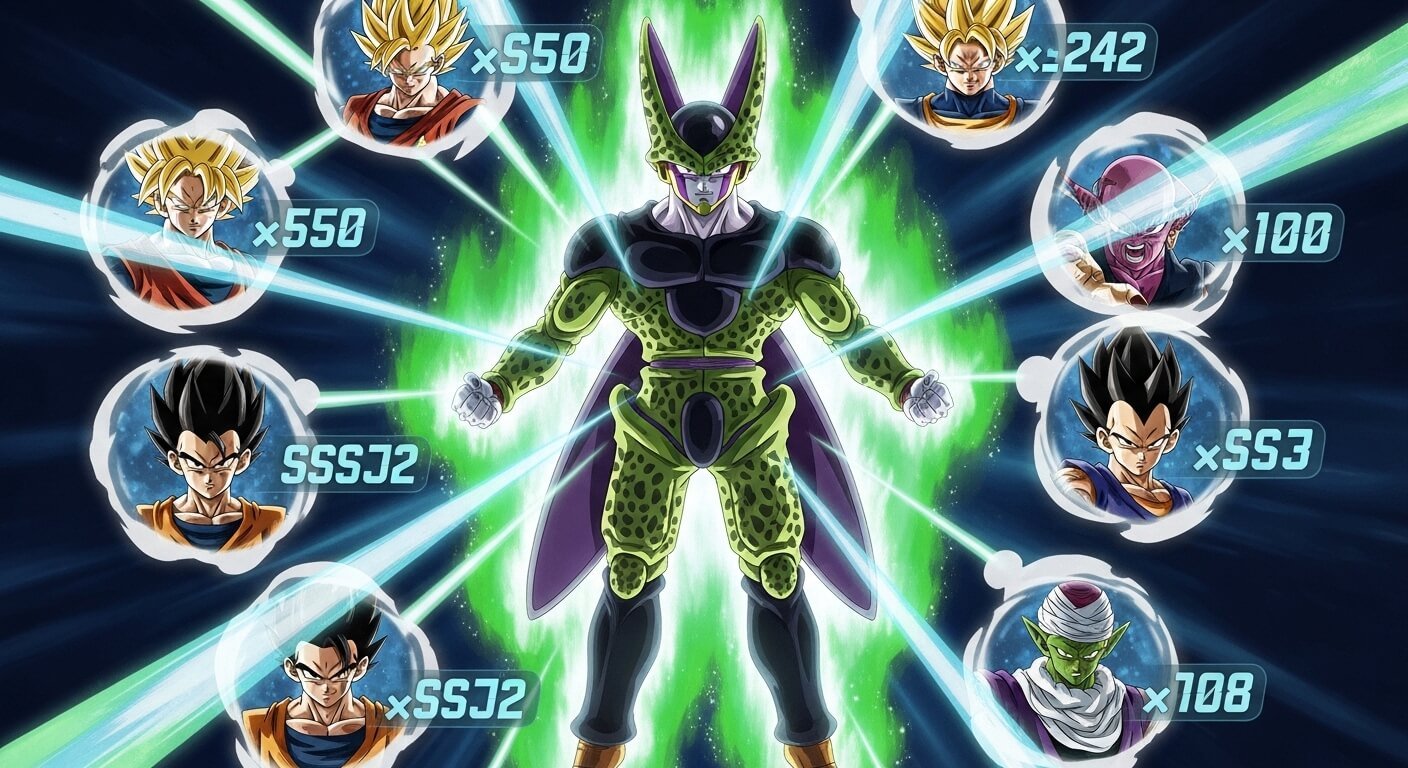
Super Saiyan Grade 2 and Grade 3 are frequently misrepresented as simply “stronger versions of Super Saiyan 1.” The manga is precise: Grade 3 — what Trunks uses — is explicitly stronger than Grade 2 in raw power, but its muscle mass increase destroys the fighter’s speed. This is why Cell dismisses it, and why Gohan’s Grade 2 outperforms Trunks’s Grade 3 in actual combat.
Power level alone does not determine outcome in Dragon Ball Z from the Cell Saga onward. This is the thesis Toriyama baked into the Cell Games — and the reason treating Cell-era power levels as numerically comparable to Frieza-era figures produces nonsense.
Image suggestion: ‘goku-super-saiyan-power-level-comparison.jpg’ — Side-by-side showing SSJ base, Grade 2, Grade 3, and Full Power forms with the speed-power tradeoff labeled
Buu Saga — Why Power Levels Stop Mattering (And Why That’s Intentional)
By the Buu arc, Toriyama had fully transitioned from power-scaling drama to character-driven drama. The arc’s climax — a Spirit Bomb fueled by every living person on Earth — works because of its emotional stakes, not because the numbers on a chart finally exceeded Buu’s ceiling.
This is why the Buu Saga is the wrong arc to mine for power level data. The series had deliberately walked away from that framework. Fans who treat Gotenks SSJ3 as a quantifiable figure versus Kid Buu’s power are applying a precision tool to material that explicitly rejected it.
What the Buu arc does give fans instead:
- Fusion power increase — Gotenks is confirmed to vastly exceed either Goten or Trunks individually, but no multiplier is canonical
- Gohan’s Ultimate form — described by Elder Kai as “beyond Super Saiyan with all limits removed,” but no number is assigned
- Vegito’s status — called “the strongest Potara fusion” in the manga, implying a power that transcends the series’ numerical scale entirely
The 5 Biggest Power Level Myths Debunked on Mangaberri
Myth 1: Super Saiyan Is a 100x multiplier.
The 50x figure comes directly from Daizenshuu 7. The 100x figure appears in the Dragon Ball Z anime’s English dub — a localization decision that contradicts the source material. Mangaberri’s manga editions, translated from the original Japanese, preserve the 50x figure consistent with Toriyama’s production notes. Every power level calculation built on the 100x assumption is inflated by a factor of two.
Myth 2: Goku’s Power Level at the Start of Z Was Already Massive
Goku’s 416 power level shocks fans who expect him to begin near Raditz. The reason it feels wrong is that anime filler portrays Goku as having trained constantly since Dragon Ball ended. The manga is explicit: Goku had a quiet domestic life on Earth, was not actively training, and was genuinely not at peak condition. His defeat of Raditz required the Kaioken — a technique that pushed his temporary ceiling far above his resting level precisely because his resting level was low.
Myth 3: All Character Power Peaks Are Documented
No canonical source gives power level figures for: Super Saiyan Goku on Namek, Perfect Cell, Super Saiyan 2 Gohan after his snap, Majin Vegeta, Super Buu with absorptions, Kid Buu, or Gohan’s Ultimate form. Every number cited for these states is a fan calculation or estimate. Some estimates are internally consistent and well-reasoned — but they are not sourced data, and presenting them as fact is where the misinformation compounds.
Myth 4: The Anime and Manga Power Levels Are Equivalent
They are not. The Dragon Ball Z anime contains filler arcs — the Garlic Jr. saga, Gohan’s high school adventures, extended Frieza planet sequences — that do not appear in the manga. Power feats shown in these arcs carry no canonical weight. Reading on Mangaberri means reading Toriyama’s authored story without those additions layered on top.
Myth 5: Fusion Multipliers Are Officially Documented
No Toriyama-approved source states a numerical multiplier for Fusion Dance or Potara fusion. The popular formula — “fusion equals the sum of both fighters’ power squared” — is fan-derived. Toriyama never solved the math because he never intended fusion to be a math problem. It was a narrative tool for raising stakes, not a formula to be back-calculated.
FAQ — Dragon Ball Z Power Levels on Mangaberri
What is Goku’s highest official power level in Dragon Ball Z?
The last canonically sourced power level for Goku is his Kaioken x4 at approximately 32,000 during the Saiyan Saga. After the Frieza arc, no official numerical figure exists for Goku in any transformation. All higher numbers cited online are fan estimates derived from multipliers applied to that baseline — educated guesses, not documented data.
Is Mangaberri a reliable source for Dragon Ball Z canon?
Mangaberri hosts the original Dragon Ball Z manga chapters as published in Weekly Shonen Jump. These represent Akira Toriyama’s authored version of the story without anime-original filler. For power level research specifically, the manga is the correct primary source, as scouter readings and character dialogue in the manga are Toriyama’s own words — not localization choices or filler writers filling airtime.
Why did Akira Toriyama stop using power levels?
Toriyama explained in interviews that the scouter system boxed him in narratively. Once fans could measure power levels numerically, they could predict fight outcomes, which killed dramatic tension. By having characters learn to suppress their ki (first shown when Goku and Gohan train before the Cell Games), Toriyama freed the story from needing internally consistent numerical logic and could focus on character and emotional stakes.
What is Vegeta’s power level in the Saiyan Saga?
Vegeta’s Saiyan Saga power level is listed as 18,000 in Daizenshuu 7 — significantly above Nappa at 4,000 and vastly above Goku’s base 416. This gap is why the Kaioken x4 was required just for Goku to compete with Vegeta’s base form. The Daizenshuu explicitly classifies Vegeta as an elite-class Saiyan warrior and Goku as a low-class Saiyan at birth — the power differential reflects that classification directly.
How do Super Saiyan transformations stack as multipliers?
Per the Daizenshuu, Super Saiyan 1 multiplies base power by 50x. Super Saiyan 2 doubles Super Saiyan 1, giving 100x base. Super Saiyan 3 quadruples Super Saiyan 2, giving 400x base. These are sequential multipliers, not additive bonuses. Super Saiyan 3’s enormous ki drain — why Goku could only hold it briefly as a living person — was Toriyama’s deliberate way of showing that raw power multipliers come with real practical costs.
Does Dragon Ball Super change the Dragon Ball Z power level canon?
Dragon Ball Super introduces a new power hierarchy — Gods of Destruction, Angels, Ultra Instinct — that functionally obsoletes all DBZ-era figures. Beerus is stated to be immeasurably beyond even Buu-era characters. For DBZ-specific power level research, Super is a separate layer that doesn’t revise the Daizenshuu figures for earlier arcs. The Saiyan Saga numbers remain what the Daizenshuu says they are — Super just renders them irrelevant to the new scale.
Where can I read Dragon Ball Z manga to verify power levels myself?
Mangaberri provides access to Dragon Ball Z manga chapters in their original serialized form. The key chapters to cross-reference are the Vegeta versus Zarbon fight on Namek, the scouter readings during the Saiyan Saga invasion, and Frieza’s dialogue about his suppressed power level. Comparing these directly against Daizenshuu 7 gives you the most accurate picture of what numerical data Toriyama actually committed to in print.
Final Takeaways
Three things every DBZ fan should understand about Mangaberri Dragon Ball Z power levels after reading this breakdown:
First: The Daizenshuu 7 is the only trustworthy numerical source, and it stops at the Frieza arc. Everything beyond Frieza’s 120,000,000 is either fan-estimated or deliberately left undefined by Toriyama.
Second: Transformations use exponential sequential multipliers, not additive bonuses. Super Saiyan 3 is 400x base — not 56x. Every chart that gets this wrong corrupts every number that follows from it.
Third: The Buu Saga was designed to make power scaling irrelevant. Treating Buu-era events as a continuation of the numerical system that governed the Saiyan and Frieza arcs misunderstands what Toriyama was doing narratively.
The next step: open the Saiyan Saga on Mangaberri, locate Vegeta’s scouter reading, and work forward from there using only manga dialogue and Daizenshuu citations. That is the only method that actually produces reliable results.
About the Author The Mangaberri Editorial Team specializes in manga canon analysis and Dragon Ball franchise history, with a primary focus on source-accurate content for the global DBZ community. All power level figures cited in this article are cross-referenced against the Daizenshuu guidebook series and the original Weekly Shonen Jump serialization.